
The gaslight in Henry Norris Russell’s Princeton study sputtered, casting long, trembling shadows against walls lined with glass plates. He rubbed eyes that felt like they were filled with sand. For hours, he had been staring at the same set of numbers, hoping they would rearrange themselves into something sensible. They refused. The data was a betrayal.
Centuries of astronomical dogma rested on a simple, comforting idea: stars are born hot and cool down, like embers in a dying fire. It was intuitive. It was safe. But the new distance measurements shattered this peace. Some red stars, which should have been cold and dim, burned with terrifying intensity. Meanwhile, blue stars, expected to be the hottest and brightest, appeared faint and insignificant. The universe was lying, or at least, it was speaking a language Russell could not yet parse. If he couldn’t make sense of this contradiction, the entire framework of stellar evolution would crumble into dust.
Russell pushed away the stack of spectral catalogs. He needed to stop thinking like an astronomer and start thinking like a cartographer of chaos. He imagined a pile of mixed fruit dumped on a table—apples, oranges, berries—a mess of color and size. Randomness is often just pattern viewed from the wrong angle. If you plot weight against color, the chaos organizes itself. He decided to apply this brutal simplicity to the heavens.
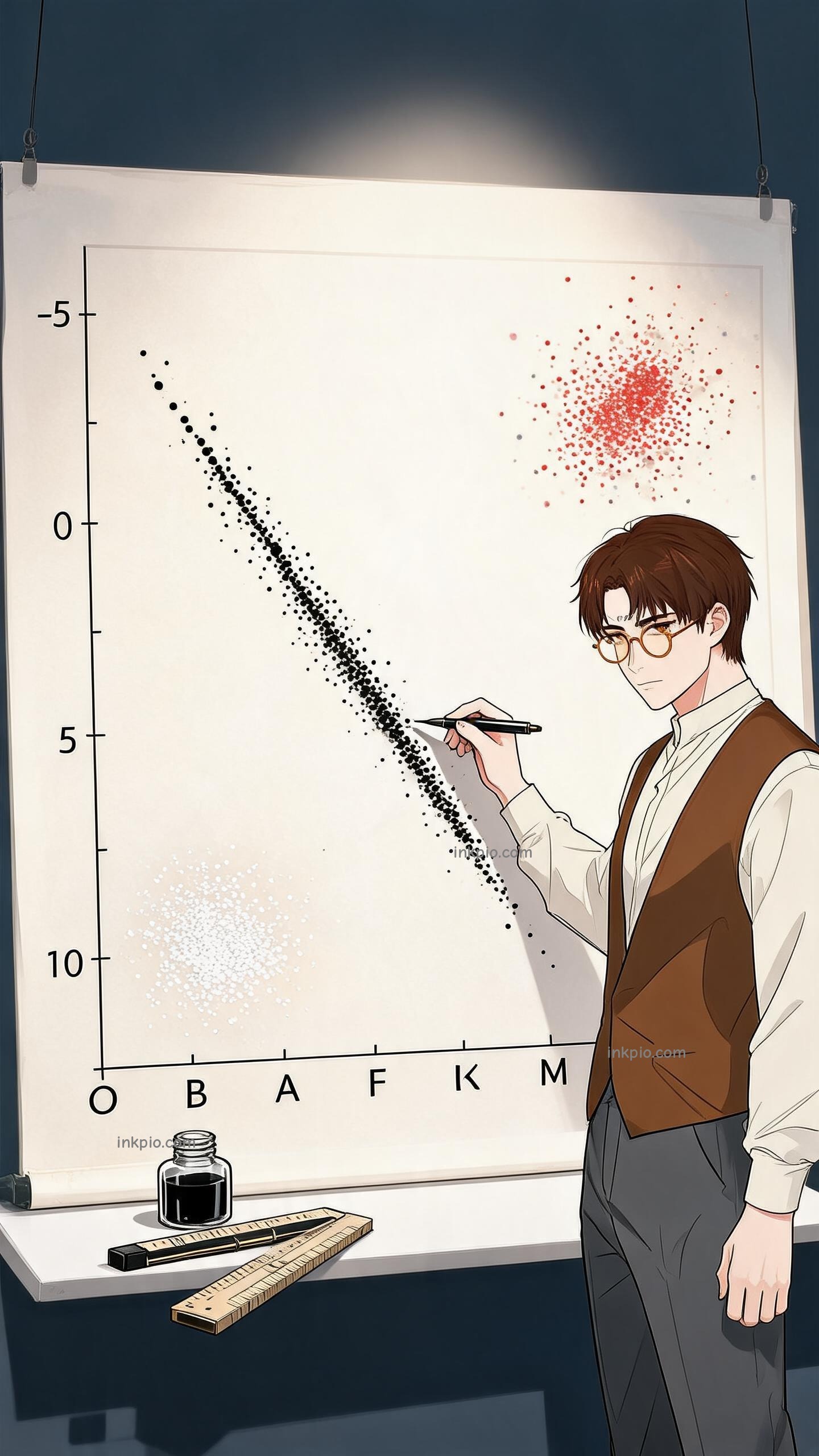
He took a fresh sheet of graph paper. On the horizontal axis, he marked the spectral type, the star’s color. On the vertical axis, he plotted absolute magnitude, the true brightness calculated from those maddeningly precise distances. His hand moved mechanically, dipping the pen into ink, transferring data from the glass plates to the paper. Dot by dot. Star by star. The silence in the room was heavy, broken only by the scratch of nib on paper and the occasional hiss of the gas jet.
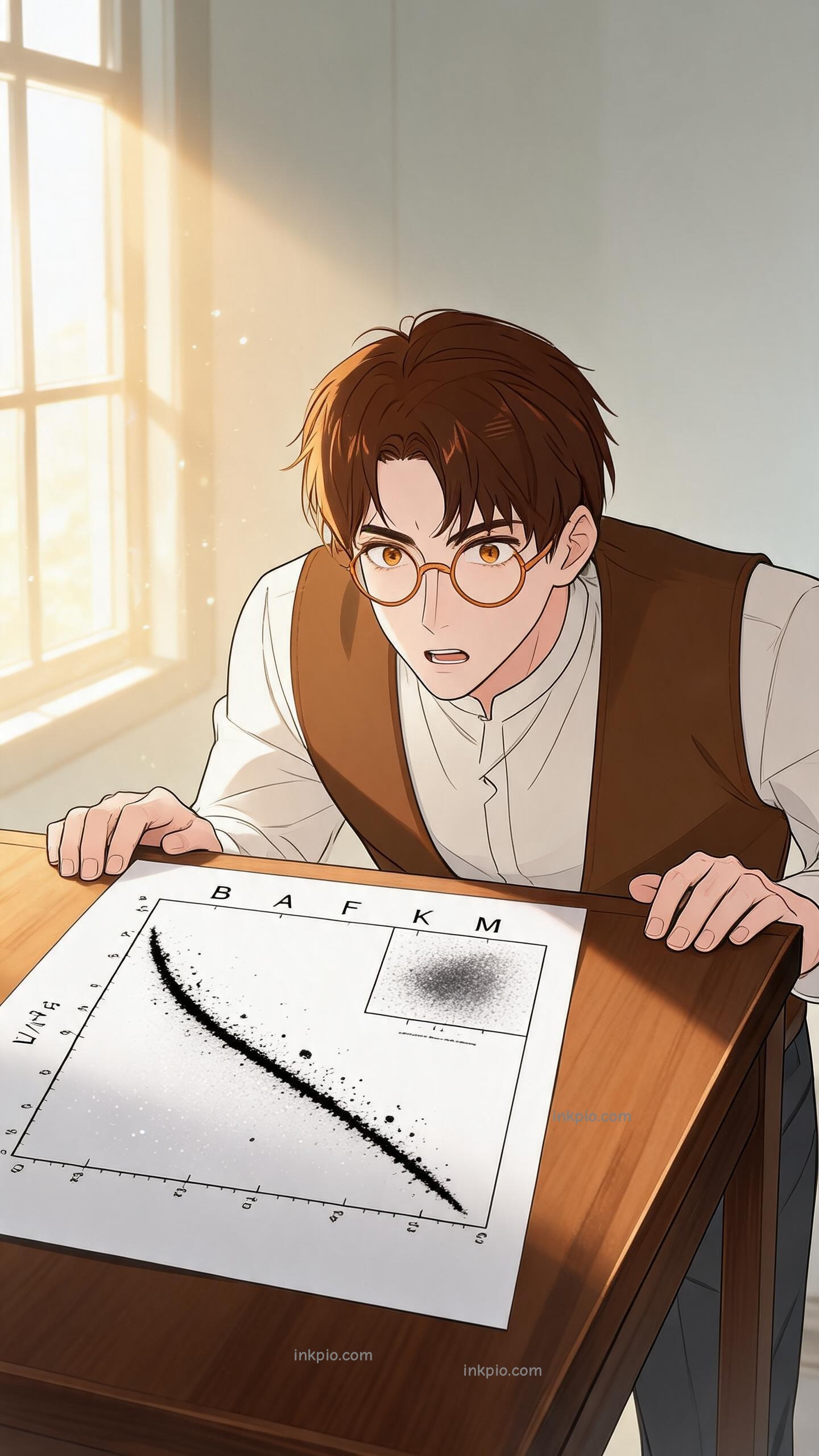
At first, the page looked like a spill of ink, a random scattering of points with no meaning. Russell’s shoulders tightened. Had he wasted months on a fool’s errand? He continued, driven by a stubborn refusal to accept disorder. Then, as the ninetieth percent of the data found its place, the noise vanished. The dots did not scatter. They aligned.
A distinct, glowing diagonal band emerged, stretching from the hot, brilliant top-left corner down to the cool, dim bottom-right. It was a road. A path. Russell stopped breathing for a moment. The few outliers—the giants and white dwarfs—clustered separately, like rebels standing apart from the crowd. But the majority followed the rule. He called it the Main Sequence.
The old cooling theory died in that instant, not with a bang, but with the quiet certainty of geometry. Stars were not just fading cinders; they were living entities with structured life cycles, moving through stages as predictable as birth and aging. Russell leaned back, his chair creaking in the stillness. He looked at the diagram, then at the dark window where the real stars hung in silent judgment. He had not just organized data; he had sketched the biography of the universe. The ink was still wet, glistening under the flickering light, holding the secret that had eluded humanity for millennia.