
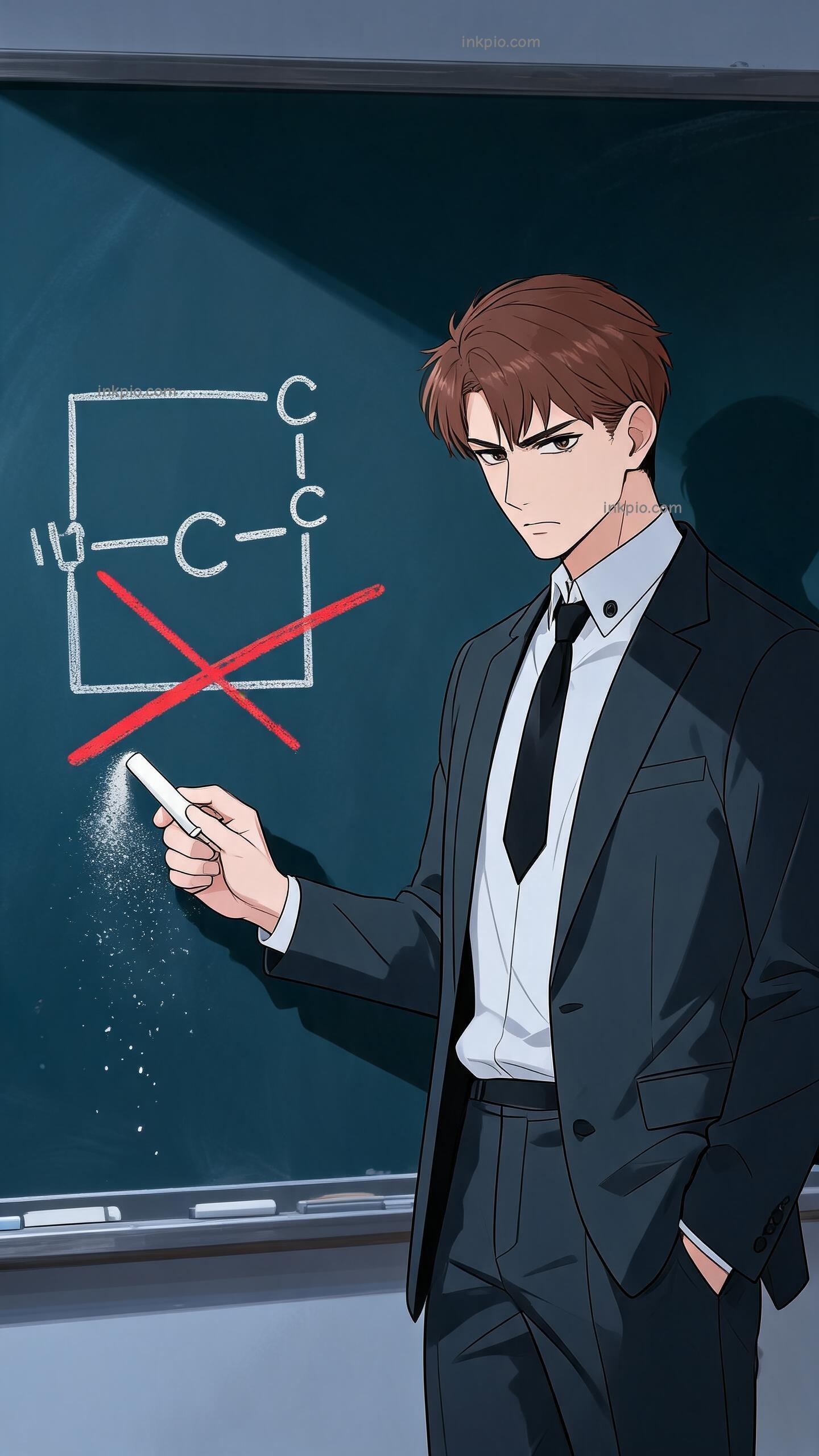




The ink on the chalkboard was dry, but the logic refused to settle. In 1874, organic chemistry felt like a house built on sand. Every time a chemist drew a carbon atom as a flat cross, the mathematics betrayed them. Swapping two attached groups should have created a new molecule, a distinct isomer. The equations demanded it. Yet the test tubes remained stubbornly silent, yielding only one substance.
This discrepancy was not just an error; it was a threat to the entire discipline. If the fundamental map of matter was wrong, nothing else could be trusted. Young Jacobus Henricus van 't Hoff sat alone in his study, surrounded by crumpled papers. He wasn't looking for fame. He was looking for sanity. The flat diagrams felt like a lie, a convenient fiction that nature refused to honor. He realized that forcing atoms into two dimensions created ghosts—differences that existed only on paper, not in reality.
He picked up a cork and four sticks. His hands moved before his mind fully formed the words. On a table, a flat cross has a left and a right. Swap them, and the shape changes. But van 't Hoff pushed the sticks out, away from the surface. He angled them into the empty air, seeking a balance that gravity and symmetry could agree on. The structure locked into place: a tetrahedron.
In this three-dimensional shape, every corner is identical. There is no left or right, no top or bottom that matters. Rotating the model reveals that swapping any two attachments merely turns the whole object. It is the same molecule, just viewed from a different angle. The input was four bonds. The operation was lifting them into space. The output was perfect equivalence. The paradox dissolved.
Van 't Hoff wrote his pamphlet, 'A suggestion concerning the three-dimensional arrangement of atoms,' with trembling hands. He knew he was challenging the established order. Colleagues dismissed his ideas as fanciful speculation. One critic suggested he take a carriage ride to see if his tetrahedral horses existed. The isolation was heavy. He was a young man shouting into a void, insisting that the world had depth while others insisted on drawing it flat.
But the models on his desk did not lie. While critics argued over notation, van 't Hoff watched the physical reality of his cork-and-stick constructions. They stood stable. They made sense. The methane derivatives finally behaved as predicted. The frustration that had plagued chemists for years vanished, replaced by a quiet clarity. He had not just solved a puzzle; he had given chemistry a body.
The scientific community would eventually catch up, but that night, the victory was private. Van 't Hoff looked at the simple wooden tetrahedron resting on his table. It was no longer just a tool for calculation. It was a key that unlocked the spatial truth of matter. The flat crosses were dead. In their place stood a shape that breathed, rotated, and existed in the real world. He blew out the lamp, leaving the model in the shadows, knowing that tomorrow, everything would look different.