


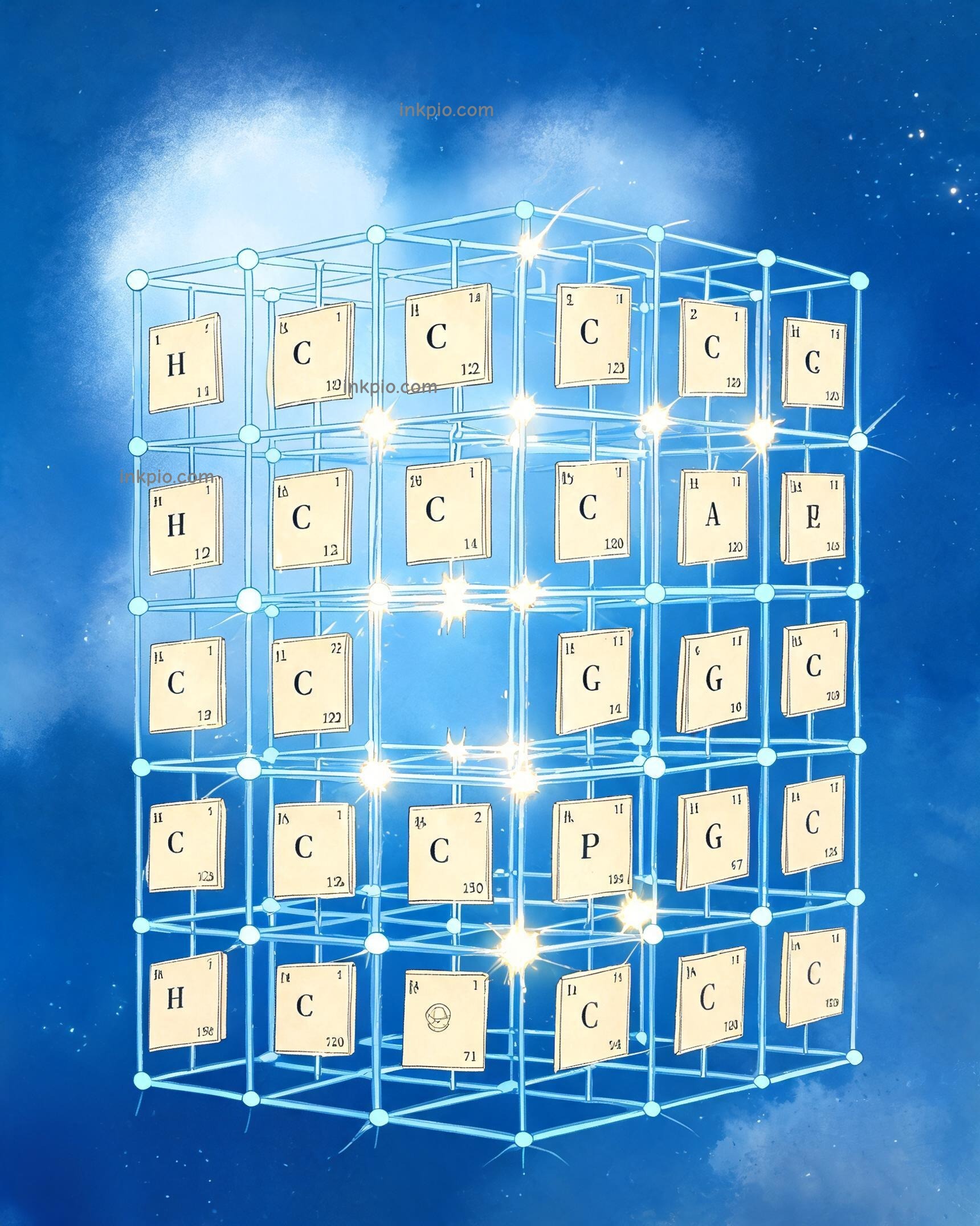


The candle flame flickered, casting long, dancing shadows across the sixty-three cards scattered on Dmitri Mendeleev’s desk. Each card bore the name of a known element, but together they formed a chaotic mosaic that refused to make sense. To the outside world, chemistry was a growing catalog of facts; to Mendeleev, it was a personal torment. He wasn't just organizing data; he was hunting for a hidden order in a universe that seemed determined to remain messy.
For days, he shuffled the paper rectangles like a gambler trying to beat a rigged deck. His fingers were stained black with ink, and his eyes burned from the strain of staring at atomic weights that wouldn't align. He tried lining them up strictly by weight, hoping for a straight line of logic. But the pattern kept breaking. Hydrogen fit neatly at the start, yet oxygen and sulfur stubbornly refused to stand with their chemical neighbors. Every time he forced two similar metals together, a rebellious non-metal would ruin the sequence. The list worked as a inventory, but it offered no prediction, no soul.
Frustration turned into a quiet desperation. If he couldn't find the rule, he feared chemistry would remain a dead end—a subject of rote memorization rather than understanding. He looked at the cards not as isolated facts, but as pieces of a broken mirror. He needed to see the whole reflection. So, he stopped forcing them into a single line. Instead, he treated them like a deck of cards being dealt into suits. He lined them up by weight, but when the chemical behavior clashed, he dropped the row down and started a new line.
The shift was subtle but profound. Suddenly, elements with similar traits aligned vertically. The weight dictated the sequence, but the shared chemistry dictated the structure. It was no longer a list; it was a grid. A rhythm emerged from the noise. Yet, the table was incomplete. Gaps appeared in the pattern where no known element fit. Most scientists would have smoothed over these inconsistencies or ignored them. Mendeleev stared at the empty spaces. They weren't errors; they were invitations.
Exhaustion finally claimed him. He slumped in his chair, the cards still spread before him, and drifted into a hypnagogic state—that hazy borderland between waking and dreaming. In this semi-conscious void, his brain continued the work his hands could no longer sustain. The scattered cards seemed to lift off the wood, floating in the dark. They snapped into place with audible clicks, locking into a rigid, perfect grid. The chaos resolved into clarity.
He woke with a start, the image burned into his mind. "I saw in a dream a table where all the elements fell into place as required," he later wrote. There was no time for hesitation. He grabbed a pen, his hand trembling slightly, and sketched the grid onto fresh paper before the vision could fade. He didn't just draw what he knew; he drew what was missing. He deliberately left blank squares where the pattern demanded undiscovered elements. It was a gamble. He was betting his reputation on the existence of things no one had ever seen.
In March 1869, he published the table through the Russian Chemical Society journal. The scientific community watched with skepticism. Who was this Russian professor claiming to predict the future? But Mendeleev waited. He had defined the properties of the missing pieces—eka-aluminum, eka-boron, eka-silicon—with precise density and melting points. Years later, when these elements were discovered, they matched his predictions exactly. The math held. The map was real.
Back in the quiet of his study, long before the world validated him, Mendeleev set his pen down. The clock ticked steadily on the wall, marking the passage of time in a room that suddenly felt ordered. The empty boxes on the page waited for nature to catch up, but the pattern was already complete in his mind. He looked at the tidy desk, the chaotic pile gone, replaced by a structure that made sense of the universe. For the first time in weeks, the silence didn't feel heavy. It felt like peace.