




The ghost of electricity haunted the physics department. Everyone knew it flowed, yet its smallest piece remained a theoretical phantom, slipping through every net scientists cast. They chased it through foggy cloud chambers and across wet glass plates, but the numbers refused to settle. The data bounced wildly, mocking their equations. For Robert Millikan, this chaos was not just an inconvenience; it was a personal insult to order. If he could not pin down the fundamental unit, the entire atomic theory would remain a house of cards, built on guesswork rather than stone.
At the University of Chicago, Millikan cleared his desk with deliberate, almost violent precision. He discarded the messy, collective methods of his predecessors. He needed isolation. He built a tight brass chamber, sealing it against the unpredictable air of the room. Inside, two flat metal plates waited. He did not want a storm of droplets; he wanted one. Just one. He sprayed a fine mist of oil and waited, his eyes straining against the microscope’s lens. The silence in the lab grew heavy, broken only by the scratch of his pen.
Gravity pulled a single, tiny oil speck down toward the bottom plate. It was a fragile thing, barely visible. Millikan turned the dial. Current surged through the metal plates, creating an upward force. He watched the drop slow, stop, and hang perfectly still in the void. It was a delicate balance, like holding a marble on a tilted tray with nothing but breath. He had to match the voltage exactly to the droplet’s weight. If he breathed too hard, if his hand shook, the illusion of control would shatter. But for a moment, the speck hovered, defying nature’s pull.
Then came the test that would break or make his life’s work. He switched on the X-ray source. The invisible rays stripped electrons from the oil drop, altering its charge. The droplet jerked upward, then froze again in a new position. Millikan’s heart hammered against his ribs. He adjusted the voltage dial, searching for the new equilibrium. The number changed, but not randomly. It snapped into place. He tried again. And again. Each shift in voltage corresponded to a precise, discrete step. The movement was not a smooth slide down a ramp; it was a climb up a staircase. Charge arrived in fixed, indivisible chunks.
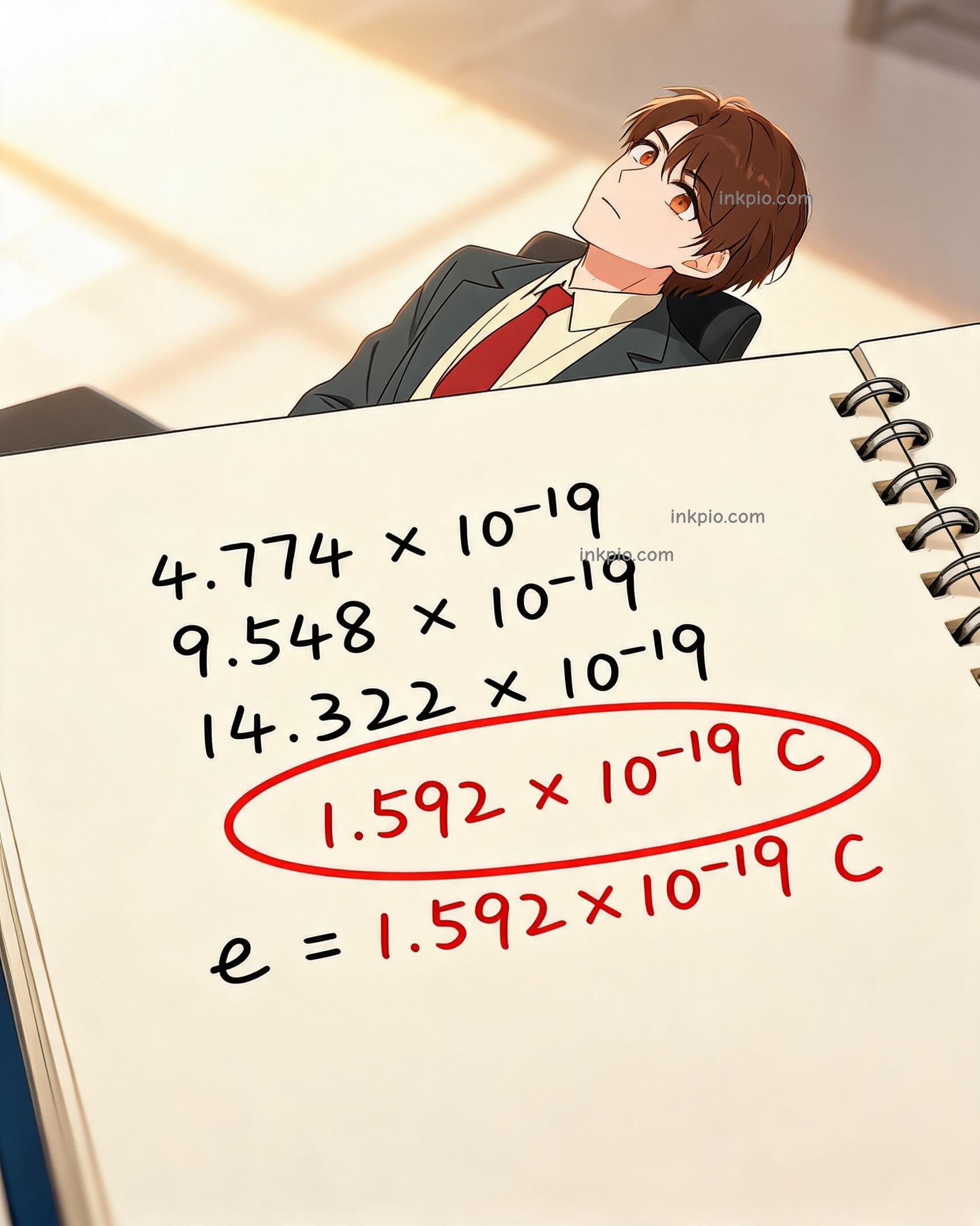
Hours bled into the afternoon. His eyes burned, dry and gritty. He tracked that single, stubborn droplet, noting every leap, every pause. The pattern never broke. The chaos of the earlier experiments was gone, replaced by a rigid, beautiful integer logic. He finally wrote the conclusion, his handwriting steady despite the exhaustion: "The charge on the drop is always an integral multiple of a fundamental unit of charge." The messy fractions that had plagued physics for decades vanished. In their place stood a single, undeniable constant.
In 1909, Millikan published the result: the elementary charge was 1.592 × 10⁻¹⁹ coulombs. The scientific world would later award him the 1923 Nobel Prize in Physics, citing this work and his studies on the photoelectric effect. But the true victory was not in Stockholm. It happened in that quiet, dust-moted lab room. Morning light washed over his desk, catching the neat columns of his notebook. The numbers sat in perfect order, no longer jumping or hiding. The invisible ghost had been caught, weighed, and locked in ink. Millikan closed the book. The silence in the room felt different now—not empty, but full of answered questions.