



Radhanath Sikdar’s fingers were stained with ink, his eyes burning from hours of squinting at columns of figures that refused to make sense. The oil lamp on his desk in Dehradun flickered, casting long, dancing shadows against the walls lined with ledgers. He rubbed his temples, trying to push back the headache that had become his constant companion. The numbers blurred, then sharpened again. He checked the arithmetic one more time, not because he doubted his skill, but because the answer felt too heavy to be true. He had just found the roof of the world without ever leaving his chair.
The Great Trigonometrical Survey of India was a machine built on patience and precision. Started in 1802 by William Lambton and later steered by George Everest, it aimed to map a subcontinent through sheer will and geometry. By 1852, the surveyors’ gaze had shifted to the Himalayas. They saw massive peaks piercing the clouds, but sight alone was a liar. The air was thick, the distance over a hundred miles, and the human eye could not pierce the optical illusions created by nature. They needed exact heights, not guesses. They needed truth carved from data.
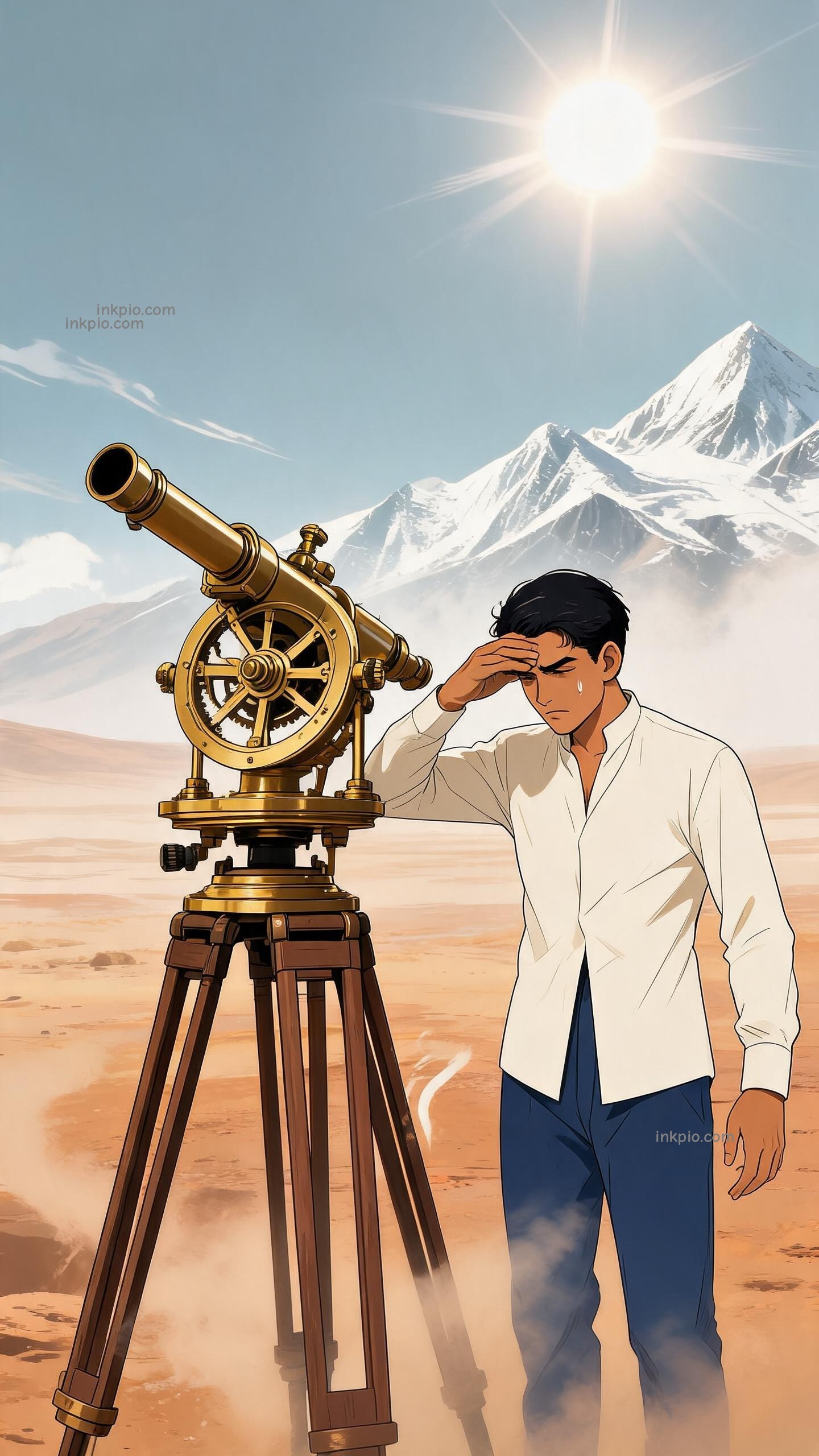
Measuring a mountain from such a distance required defeating the atmosphere itself. Imagine looking at a coin at the bottom of a swimming pool; the water bends the light, making the coin appear shallower than it is. Sikdar held the raw angles from brass theodolites as his starting point, but these were distorted by reality. The Earth curved beneath the line of sight, and the dense Himalayan air bent the light just like that pool water. His job was to calculate exactly how much the light lied, subtracting that optical illusion to reveal the true vertical height.
Sikdar sat in the quiet hum of his office, crunching trigonometric data sent from stations far away. He applied correction after correction, peeling back layers of atmospheric refraction and Earth’s curvature. Each calculation was a battle against uncertainty. The numbers shifted under his pen, resisting a final form. He worked with a quiet desperation, aware that a single decimal error could erase years of fieldwork. Then, the final calculation for Peak XV locked into place. The chaos of variables resolved into a single, undeniable integer.
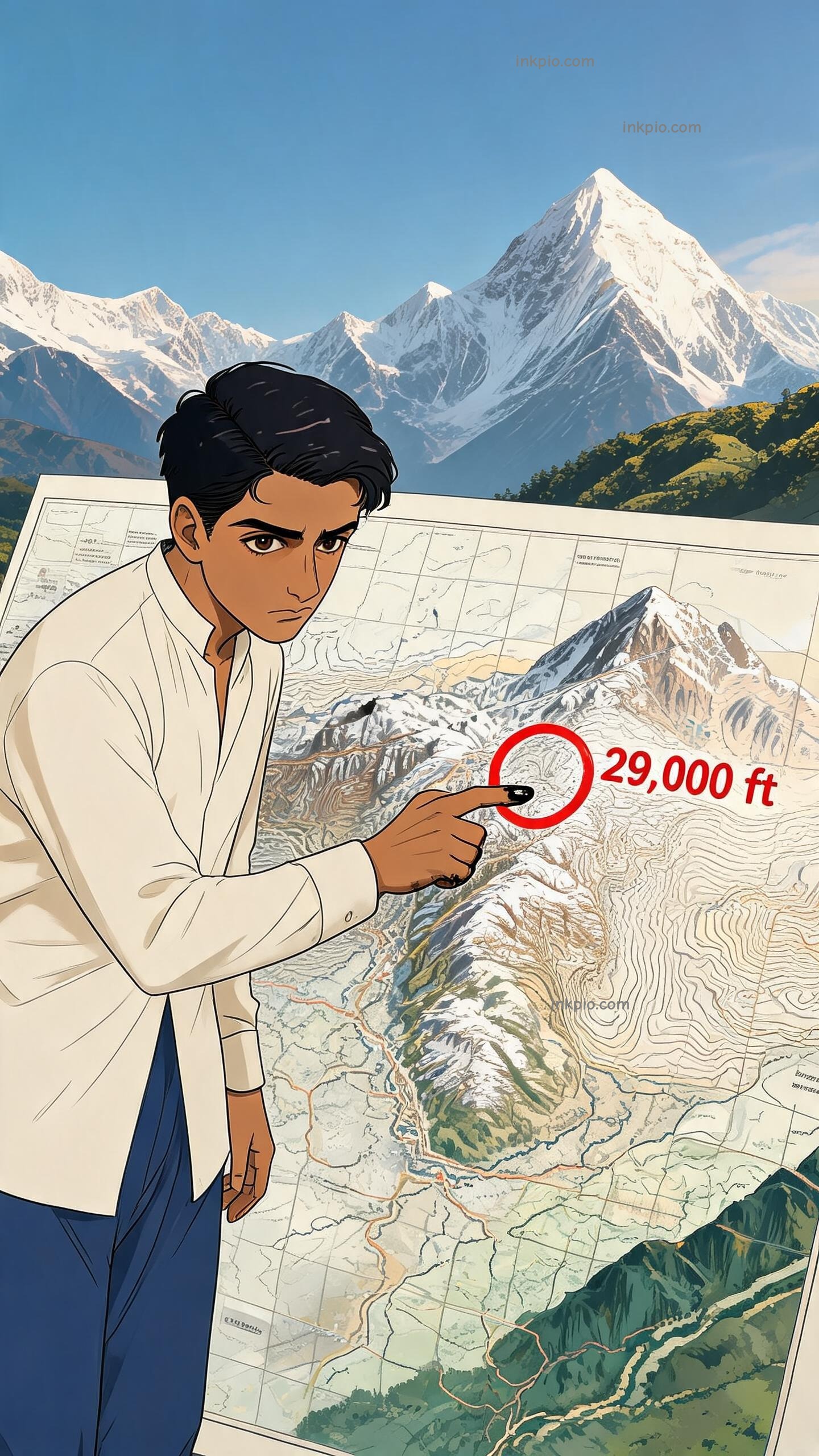
The math spat out a staggering number: 29,000 feet. It was so round, so perfect, that it looked like a guess. Sikdar knew how skepticism worked. To prove the rigor of his work, he added two extra feet, writing down 29,002. It was a small act of defiance against doubt. The reality stood clear to everyone in the room. Peak XV dwarfed everything else on the map. The silence in the office was heavier than the mountains themselves.
George Everest, the survey’s leader, would have his name attached to the peak in 1865, a honor that skipped over the man who actually measured it. Sikdar remained a 'computer,' a human processor in the background of history. Decades later, climbers would bleed and freeze on those snowy slopes, fighting for every inch of altitude. They would call it conquest. But the first conquest was silent. It happened in a dimly lit room, with the scratch of a pen and the smell of old paper. A man who never saw the mountain had touched its summit, holding the weight of the world in his hands.