



The wooden tool snapped right down the middle. Another planetary forecast missed its mark by three full days. Ptolemy’s old sky model forced planets to speed up and slow down at random spots, which shattered the ancient rule that celestial motion must stay perfectly steady. Tusi tried patching the math with extra loops and sharp angles, but the parchment kept tearing under conflicting calculations. He needed a clean way to make a planet drift back and forth while keeping its speed perfectly uniform.
He stepped away from the ruined charts and watched a brass circle roll inside a heavy iron loop on his stone table. The smaller ring spun smoothly against the outer edge, never catching or slipping. A single chalk dot painted on the inner rim moved forward, reversed, and carved a dead-straight line across the dark slate. Two perfect circles, locked in motion, somehow erased their own curves. The steady rhythm of the rolling metal held his attention, but that chalk trace was the real answer.
The trick relies on simple proportions. The outer loop stays fixed. The inner ring measures exactly half the width and turns at the exact same pace. As it rolls, the spin pushes a point on the rim one direction while the forward roll pulls it back the other. Those two movements cancel out every sideways drift and leave only clean, straight oscillation. Tusi saw the solution instantly and sketched the nested pair onto a fresh sheet.
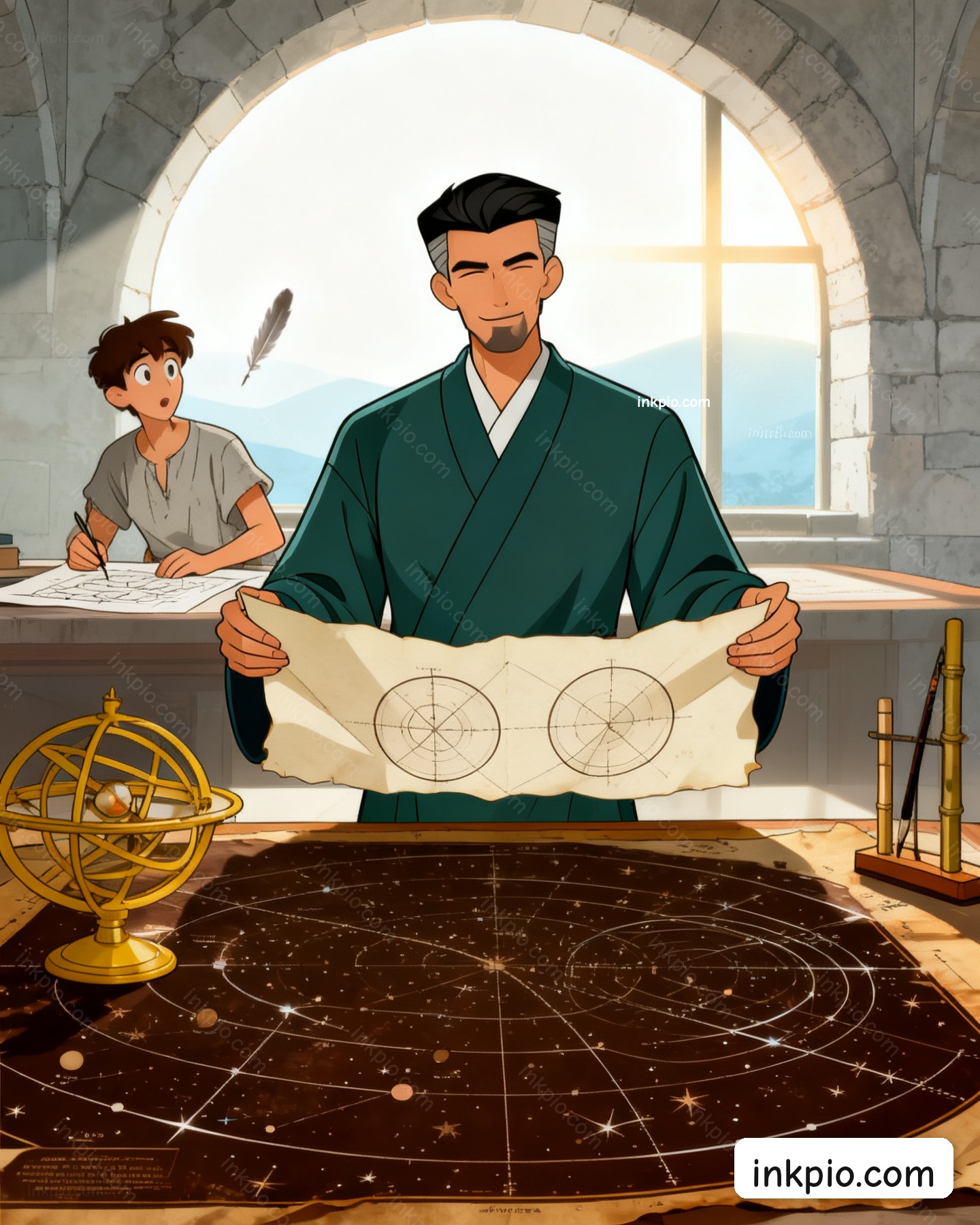
He laid the new diagram over the broken star map. The wandering tracks finally snapped into alignment without breaking any rules of steady motion. Hulagu Khan had funded the Maragheh Observatory in 1259 to map the heavens, and by 1260 the geometry finally matched reality. Behind him, a junior scholar set down his writing pen and watched the morning light flood across the corrected grid. The messy arcs from the night before were gone.
The metal rings settled into silence on the desk, but the sky above finally stayed on schedule.