

The match flared, a tiny star against the gloom of the Panthéon. Léon Foucault held his breath as the flame licked the thin hemp rope holding the 28-kilogram brass bob. He wasn't just burning a cord; he was severing the last tether to certainty. For weeks, doubt had gnawed at him. The scientific elite knew the Earth spun, yet their bodies felt only stillness. This disconnect was an itch they couldn't scratch, a truth they couldn't touch. Foucault needed to make the invisible undeniable.
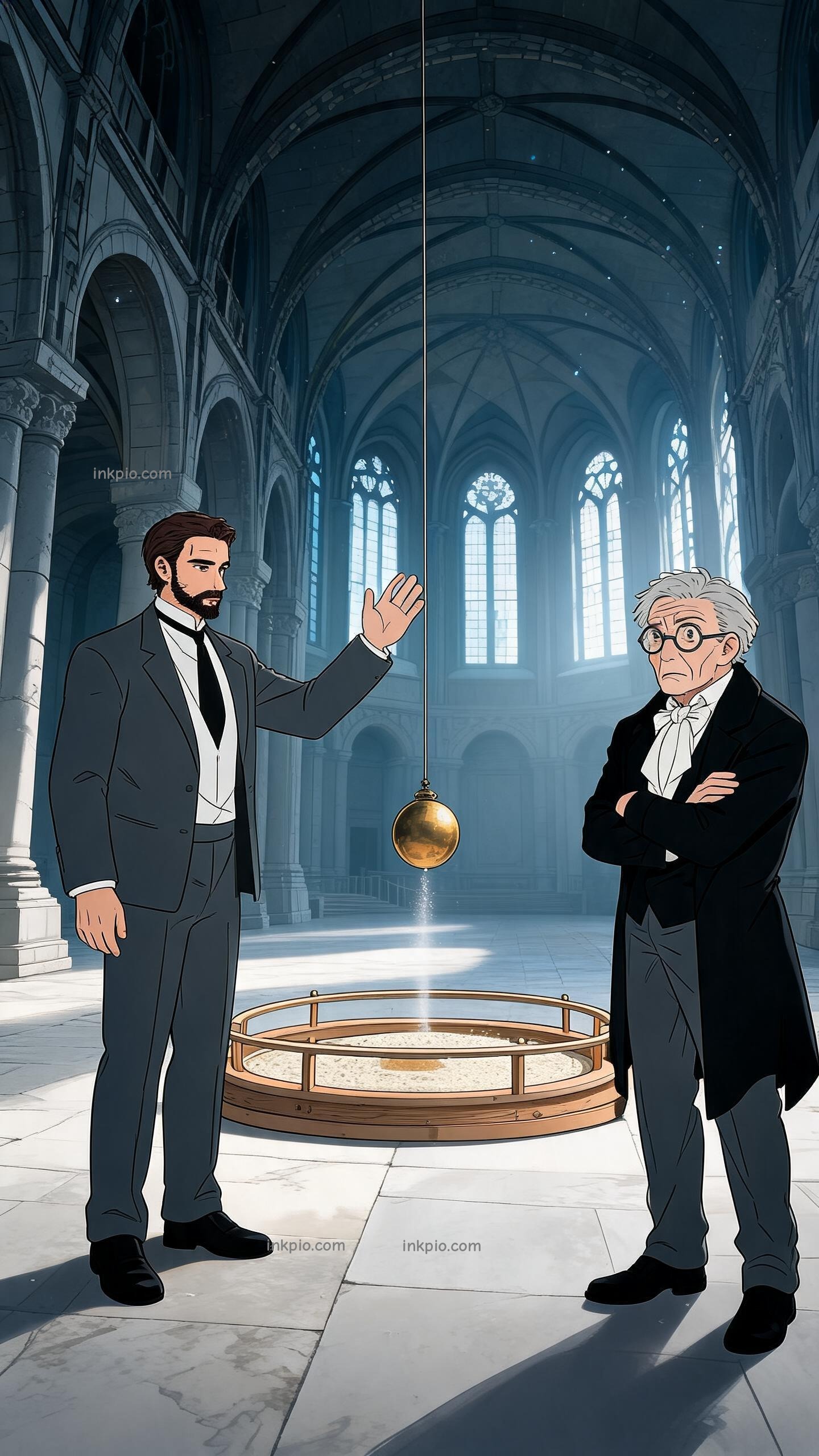
Weeks earlier, in the cramped confines of the Paris Observatory, he had tested the concept with a modest 5-meter wire. It worked, but it felt like a parlor trick. To silence the skeptics, he needed grandeur. On March 31, under the soaring dome of the Panthéon, he suspended the heavy bob from a 67-meter steel wire. A sharp stylus hung from the bottom, hovering millimeters above a circular tray of pale sand. The setup was fragile, exposed, and terrifyingly simple.
The physics relied on inertia, a stubborn refusal to change direction. Imagine a marble rolling straight across a spinning merry-go-round. To the rider, the path curves. To the marble, it is straight. Foucault’s pendulum was that marble. It demanded to swing in one fixed, unchanging plane. The sand tray below was the canvas. If Paris stood still, the stylus would carve the same groove repeatedly. If the city moved, the grooves would drift.
Silence descended on the crowd. It wasn't the polite quiet of a lecture hall, but the heavy, suffocating hush of collective skepticism. An older academician stood near the railing, arms crossed tightly over his chest. His posture screamed defiance. He wasn't there to learn; he was there to witness a failure. He watched the brass ball swing back and forth, a metronome counting down to embarrassment. Every second that passed without visible movement felt like a victory for the static world he believed in.
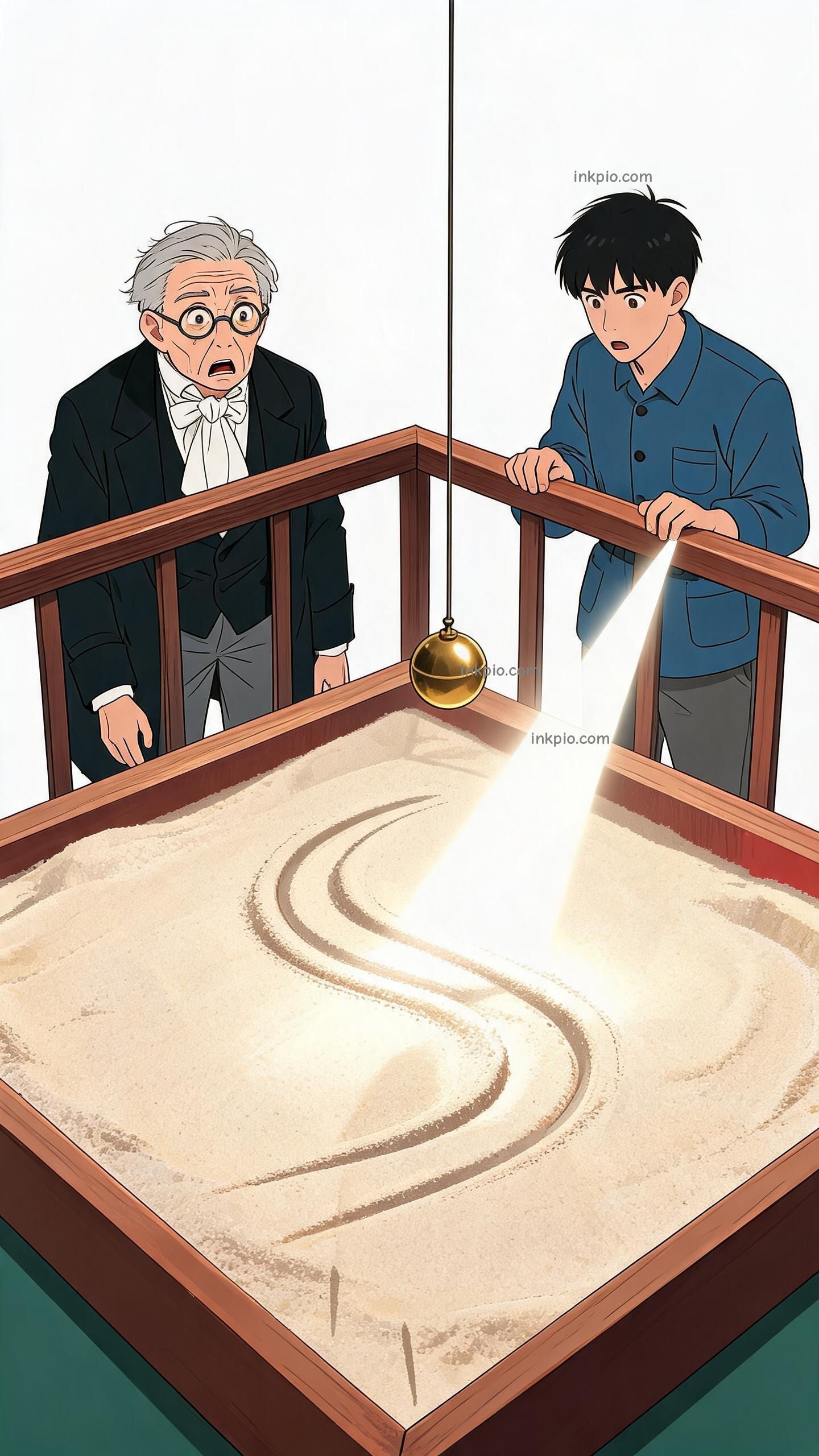
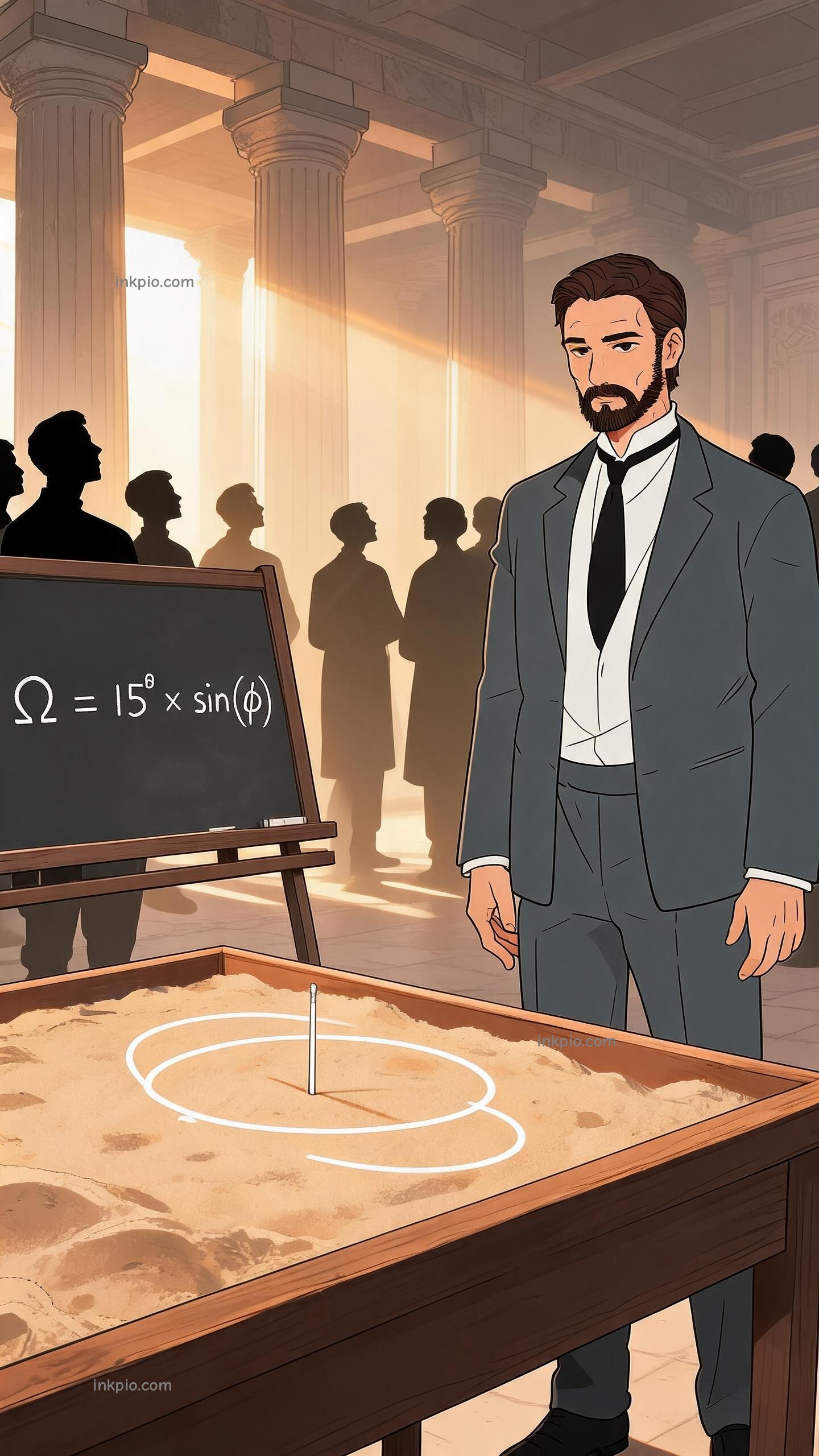
Hours bled into one another. The light in the dome shifted, casting long, creeping shadows. Then, the impossible became visible. The fresh track in the sand did not align with the old one. It had shifted. Slowly, imperceptibly to the naked eye but undeniable in accumulation, the line rotated clockwise. The rate was precise: 11 degrees per hour. The math was cold and absolute: Ω = 15° × sin(φ). At Paris’s latitude, the ground was turning beneath the steady pendulum, completing a full 360-degree cycle in roughly 32 hours.
The academician’s arms uncrossed. He didn't speak. He didn't need to. He stepped closer to the sand, his eyes tracing the diverging lines. The realization hit him not as a formula, but as a physical sensation of vertigo. The floor beneath his feet was no longer solid ground; it was a moving platform. The pendulum hadn't moved. The world had.
Foucault watched the man’s face, not the sand. He saw the moment the skeptic’s arrogance dissolved into awe. The brass bob continued its rhythmic sweep, indifferent to the drama it caused. It swung in its perfect, invisible rhythm, dragging the Earth's rotation out into the open. The crowd remained silent, but the quality of the silence had changed. It was no longer skeptical. It was the quiet of people realizing they are standing on a spinning stone, hurtling through the void, held in place only by gravity and grace.