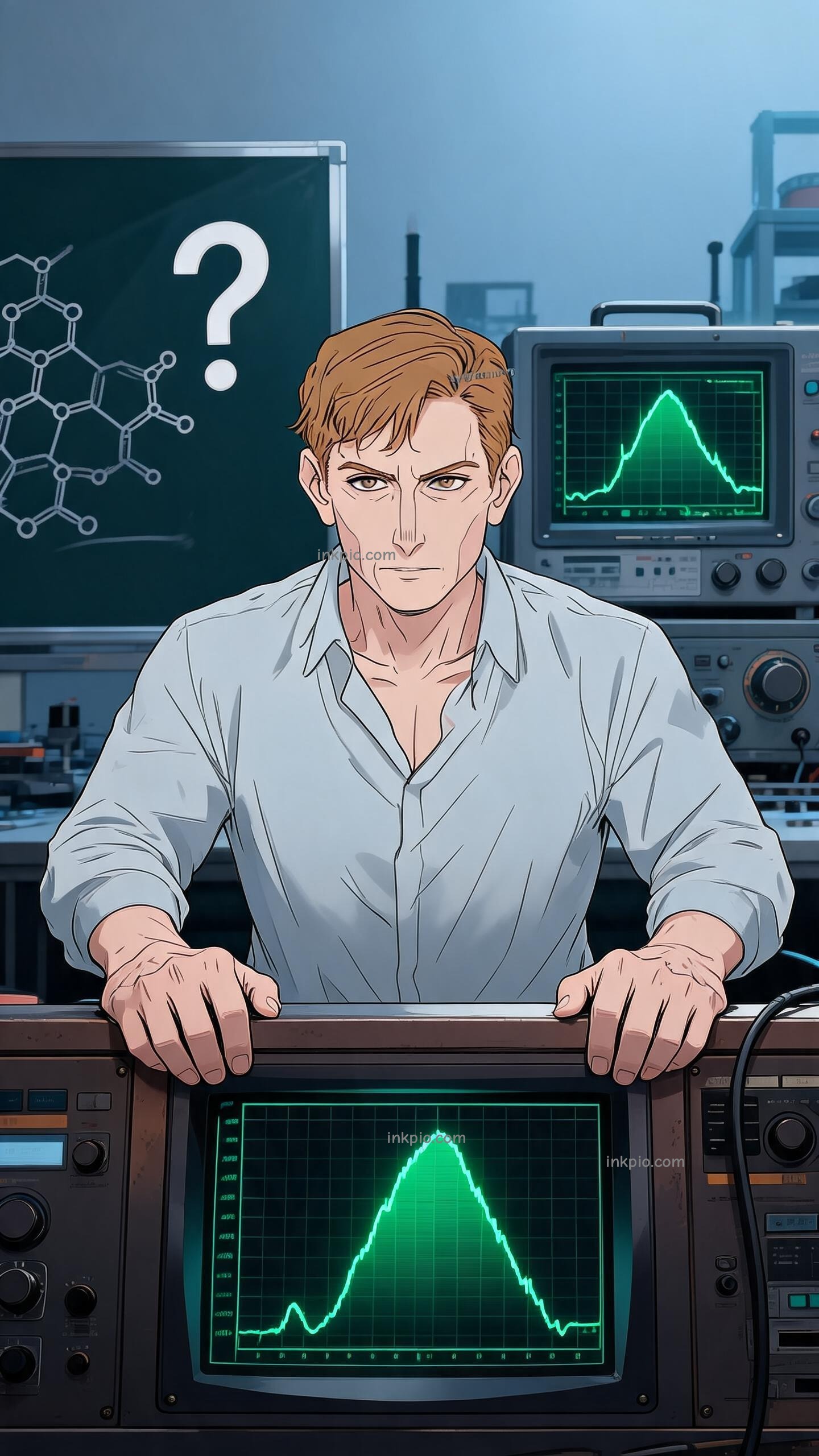
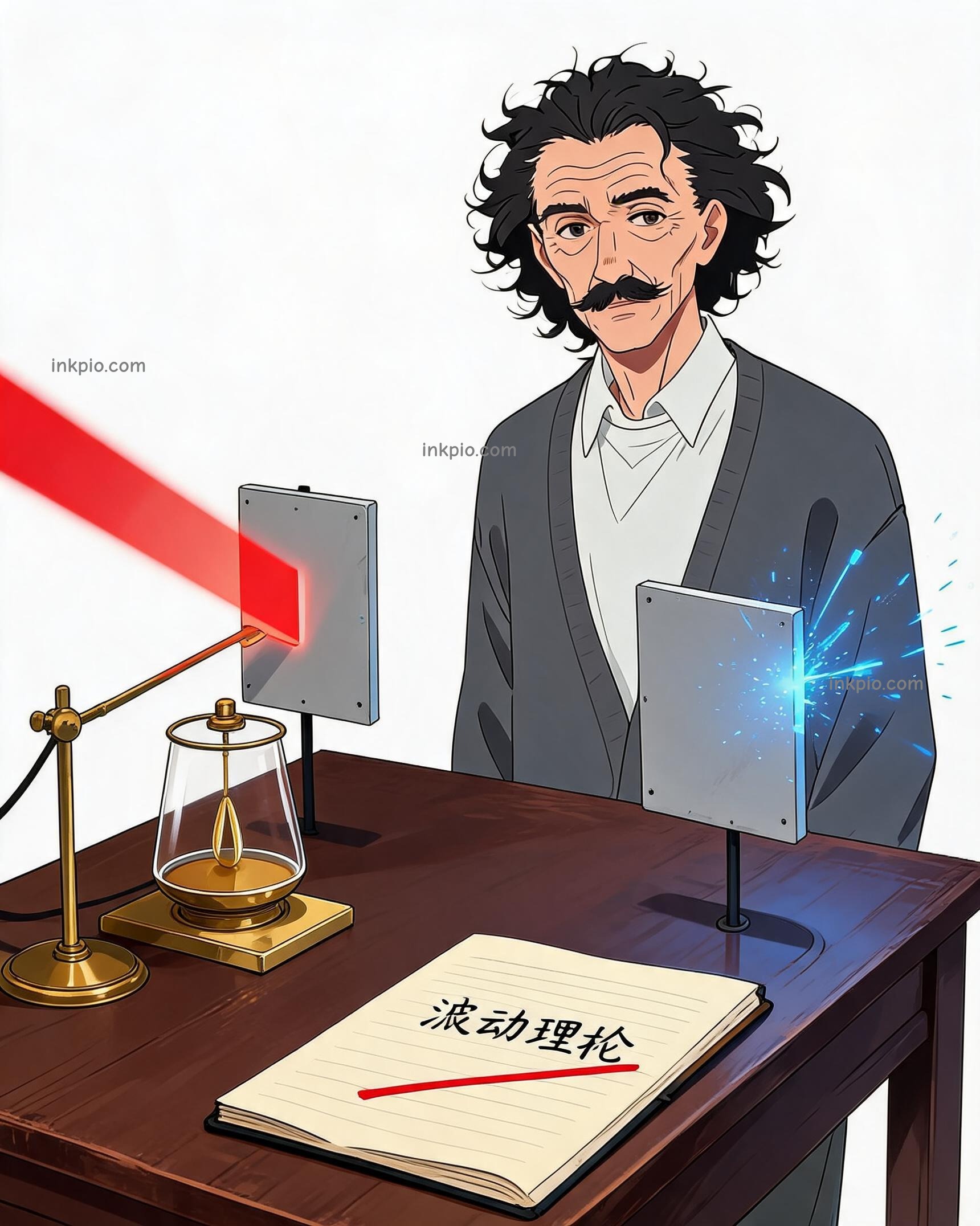

The red light was blinding, a torrent of energy crashing against the metal plate. Yet the galvanometer needle remained dead still. Not a single electron had been knocked loose. Then came the blue light, faint and ghostly, barely visible in the dim lab. Instantly, the needle jumped. Electrons flew off the surface as if startled by a sudden noise.
This simple contradiction terrified the physics community. For decades, light had been understood as a wave, elegant and continuous like ripples on a pond. Logic dictated that a brighter wave carried more energy. If you shouted louder, the wall should shake harder. But the metal refused to listen to volume; it only responded to pitch. The foundation of classical physics was cracking under the weight of a silent, stubborn fact.
In Bern, Albert Einstein sat at his desk in the patent office, surrounded by stacks of mundane applications. He was not a professor in a grand hall, but a clerk checking if inventions worked. This distance from academia gave him a dangerous freedom. He looked at the failed experiments and felt a cold clarity. The wave theory was beautiful, but it was wrong. Light was not a river. It was a hailstorm.
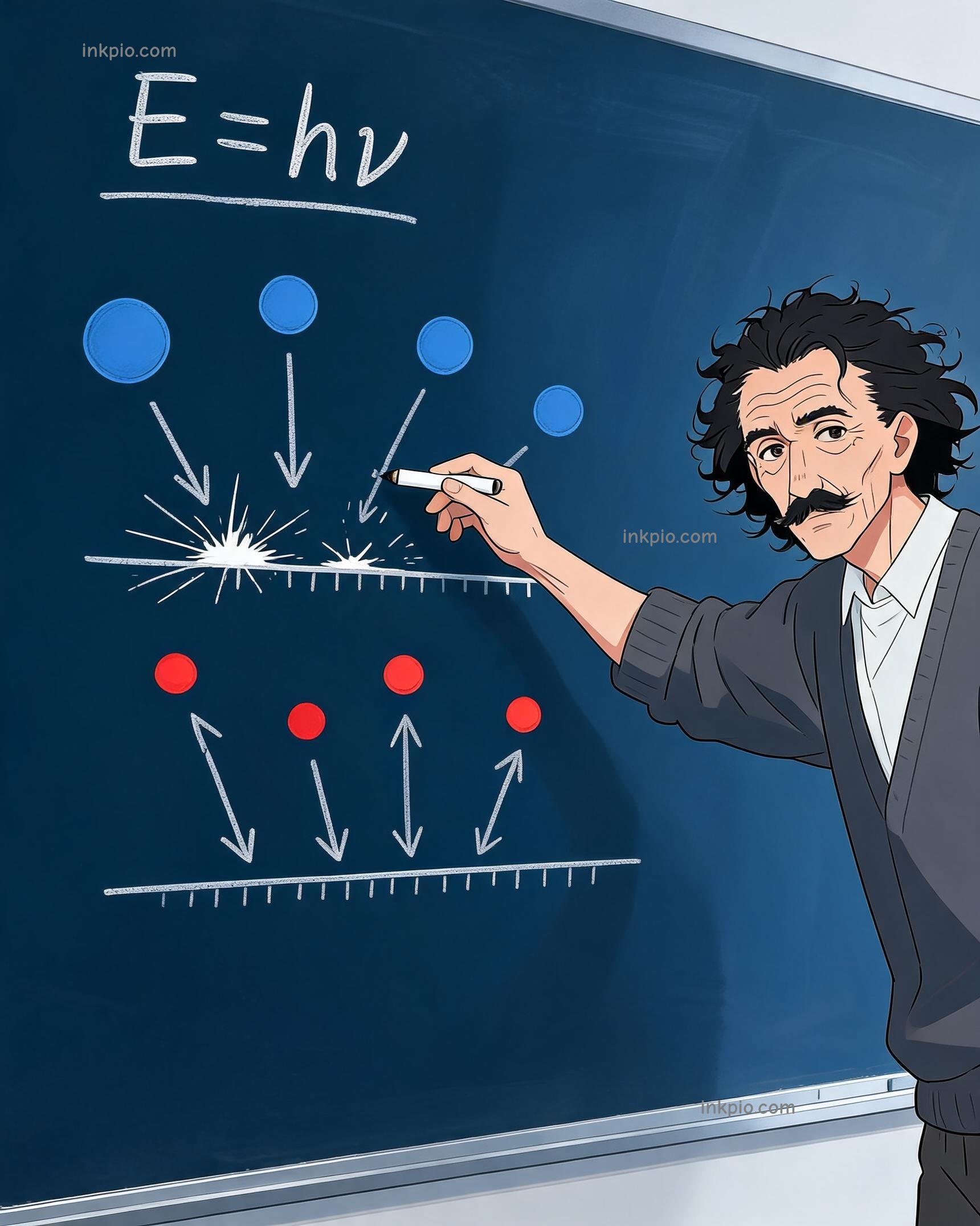
Einstein imagined light as discrete packets, tiny bullets of energy he called quanta. He used a metaphor that stripped away the mathematical elegance physicists loved. Imagine trying to crack walnuts hanging from a tree. Red light is like a shower of copper pennies. You can throw a million pennies at a walnut. They will clatter and bounce off, but none carries enough force to break the shell. The walnut remains intact, no matter how rich the rain of coins.
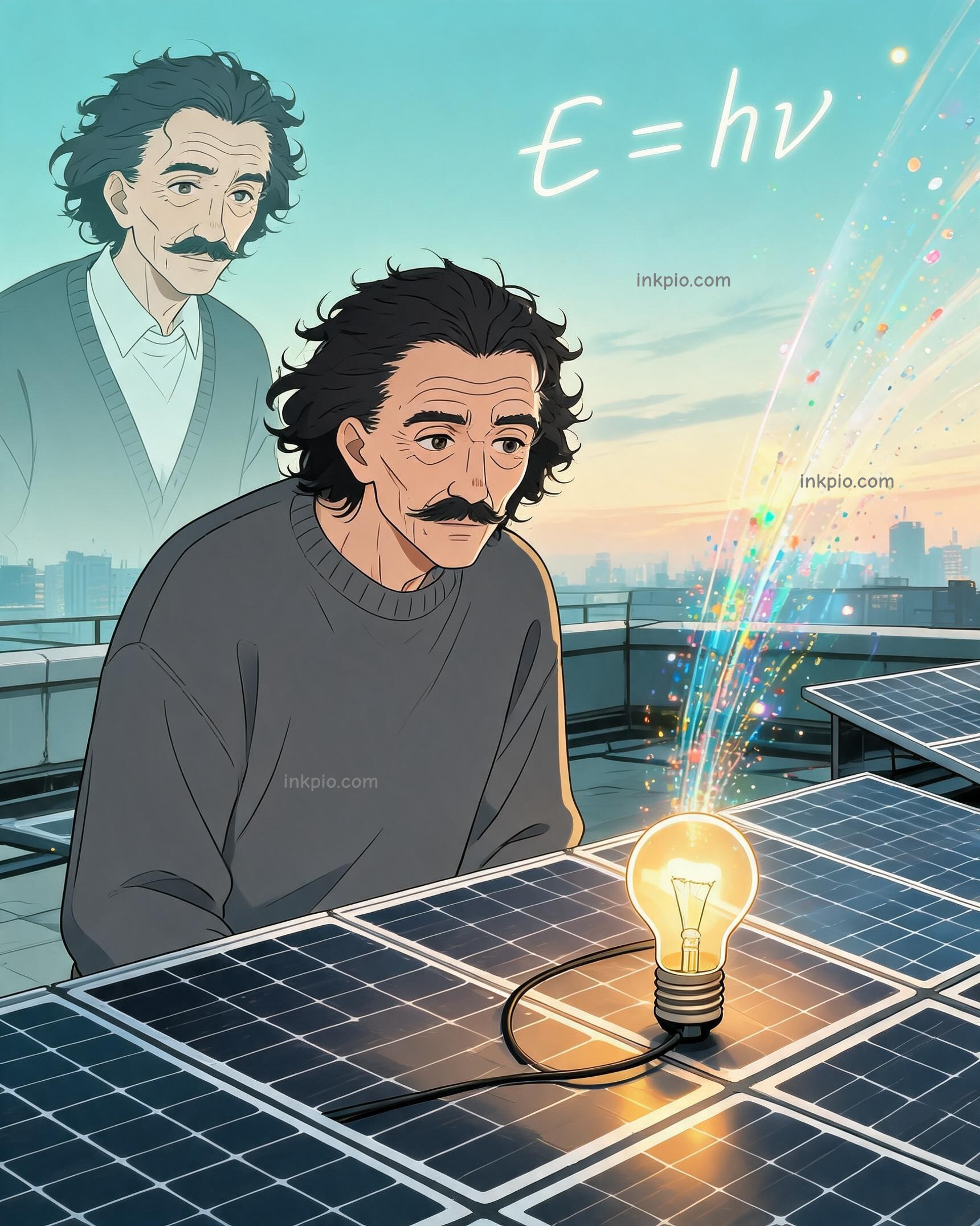
Blue light, however, acts like heavy silver dollars. Even a single coin, thrown with precision, carries enough kinetic punch to shatter the hard shell on impact. The number of coins matters less than the weight of each individual one. This was the radical shift: energy depended on frequency, not intensity. The equation E = hν was not just math; it was a new way of seeing reality. Each photon had to be strong enough on its own to do the job.
When he published this idea in 1905 in the Annalen der Physik, the reaction was not applause. It was silence, followed by discomfort. Peers felt he was tearing down a cathedral to build a shack. Waves were smooth and predictable; particles were chaotic and primitive. To suggest light was chunky felt like a step backward into darkness. Einstein waited, isolated in his certainty, watching the scientific world turn away from his insight.
Robert Millikan, a meticulous experimentalist in Chicago, decided to destroy this idea. He did not want to confirm it; he wanted to bury it. For ten years, he worked in isolation, refining his apparatus to eliminate every possible error. He hated the simplicity of Einstein’s claim. It seemed too easy, too clean for the messy reality of nature. Millikan poured his career into proving the patent clerk wrong, driven by a deep need to restore order to the chaos.
By 1914, the data was undeniable. Millikan stared at his notebooks, his hands likely trembling not from excitement, but from defeat. His precise measurements aligned perfectly with Einstein’s equation. He had calculated Planck’s constant to within half a percent of its true value. In trying to crush the theory, he had forged its strongest armor. He wrote up the results, knowing he had accidentally validated the very idea he despised.
The Nobel Committee recognized this irony in 1921. They awarded Einstein the prize specifically for the photoelectric effect, ignoring the relativity work that made him famous. It was a quiet victory for the man who saw light as bullets. Today, that same principle lives in the silicon of solar panels on rooftops. Photons strike the cells, knocking electrons free in a silent, invisible dance. The screen you read this on glows because a century ago, a clerk dared to see light not as a wave, but as a storm of heavy coins.