



The imperial grain ships kept vanishing into the South China Sea. Sailors guessed their course, and the ocean swallowed them whole when storm clouds erased the coastline. Dead reckoning only worked until the sky closed up. Yi Xing watched the casualty reports pile up in the capital and decided to stop looking at the water. He looked straight up instead.
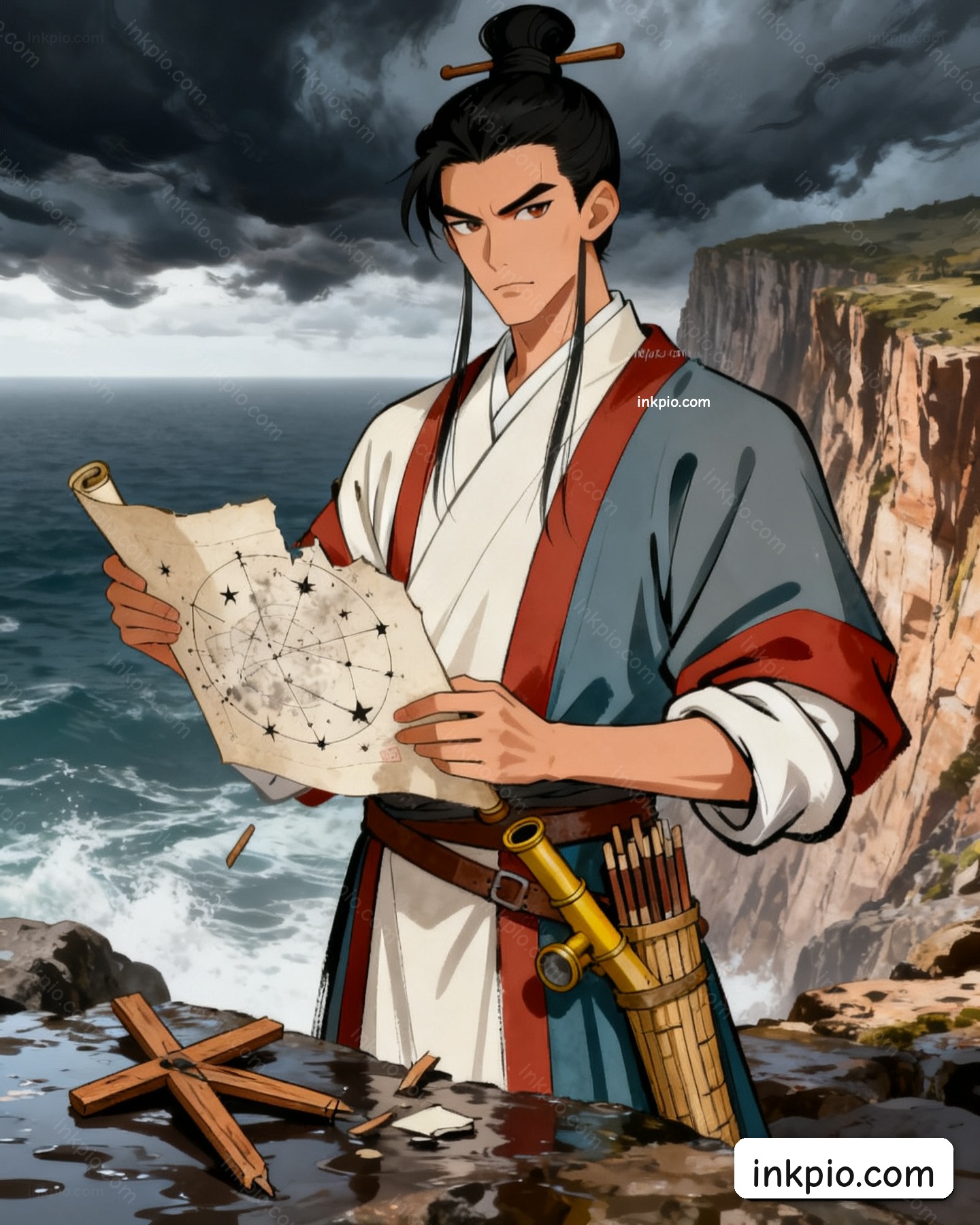
In 724 AD, he organized a meridian arc survey across 13 locations from Jiaozhou to Weizhou to measure terrestrial distance. He knew the North Star barely shifted while the rest of the sky spun around it. Every clear night, he braced hollow bamboo tubes on heavy limestone slabs and tracked where the star’s light fell. He treated the heavens like a slow-moving escalator. If a ship sailed a set distance north, the star should rise by a matching step. He just needed to catch that step on stone.
The setup turned abstract angles into something he could measure with his feet. The bamboo tube pinned the celestial angle to the ground, and the carved grid turned the falling shadow into a readable scale. Survey teams paced the rough terrain between stations, laying out thick knotted ropes to mark the exact ground distance. After months of damp nights and careful tallying, the numbers finally locked together. Traveling precisely 351 li and 80 bu north changed the star’s altitude by exactly one degree. The ratio held steady across all thirteen sites.
Mariners finally had a way to check their position without rolling dice on the tide. They measured the star’s height through the tube, matched the shadow to the stone scale, and knew their exact latitude before the coast came into view. A blank patch of ocean stopped looking like a graveyard. Yi Xing unrolled a fresh parchment map on his desk, traced a steady route along the coast, and slid it toward the waiting captains. The sky had finally handed them a chart they could actually use.