



Rain hammered the canvas tent on Príncipe Island, and Arthur Eddington watched the storm swallow his equipment. He had traveled halfway across the world to catch a fleeting shadow, but the sky kept refusing to cooperate. The date was May 29, 1919, and the war in Europe had just ended. Now, he needed the clouds to clear for exactly five minutes. Without that window, a quiet theory from a Swiss patent clerk would stay just another idea.
He needed to catch a bend in light, not a force pulling it. Einstein’s math said mass warps space like a heavy stone dropping onto a stretched canvas, forcing anything rolling past to curve inward. The plan was straightforward. A camera captured the Hyades star cluster during the eclipse, locking their positions onto glass plates. Months-old reference photos showed where those stars normally sat. Sliding the new plates over the old charts revealed any outward shift, proving space itself had warped. Newton’s old rules predicted a tiny 0.87 arcsecond move, while Einstein’s equations demanded nearly double that.
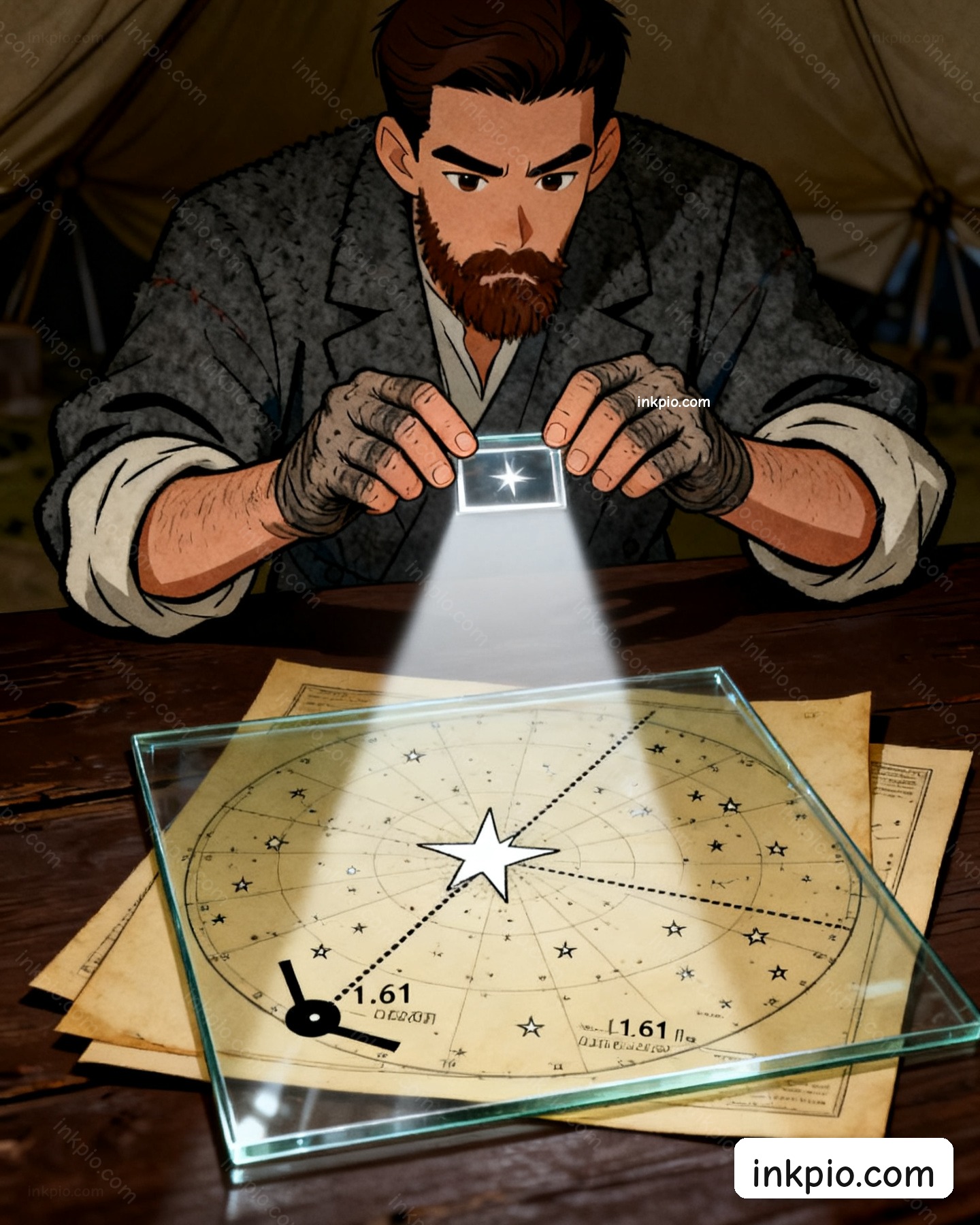
The storm broke right as the moon slid over the sun. Edwin Cottingham called out from the mud, and Eddington rushed to the brass telescope to swap glass plates in frantic bursts. The clouds tore open just long enough to expose the film before darkness and rain returned. Later that night, under a weak lamp, he slid the developed glass over a paper star chart. The numbers didn't lie. The Hyades cluster had shifted exactly 1.61 arcseconds from its usual spot.
The final reading landed squarely near Einstein’s prediction of 1.75 arcseconds, leaving Newton’s 0.87 completely behind. Space really did bend around mass. Eddington skipped the long paper and tapped a quick telegram to London instead. Through clouds. Hopeful. Results confirm Einstein. The storm finally passed, leaving the damp tent quiet and the measured plates ready for the journey home.